News / 10 October 2026
MOF pastry: the title, the competition and the VoilaChef Chefs
MOF pastry: what the title requires, how the competition works and why training with an MOF changes your approach in the kitchen.
VoilaChef
10 October 2026
In this story
An MOF pastry title cannot be bought, cannot be earned in a day and should not be confused with a CAP qualification. It is a state title, awarded after a competition lasting several days before a jury of peers. It also identifies a potential instructor: VoilaChef brings together MOF titleholders and World Champions in pastry and confectionery, chocolate and confectionery, bakery and ice cream.
There is, however, a gap between the reputation and the everyday reality of the profession. Lists of winners are available, explanations of how the competition works are less common, and almost nothing addresses what the title changes when you are looking to improve. That is the subject of this article.
At a glance
-
A state title, formalised in 1935: COET-MOF organises the examination, and the ministry responsible for national education awards the diploma.
-
A periodic competition, rather than an annual one: the Pastry and Confectionery class opened in 2011, 2015, 2019, 2023 and 2026.
-
28th session, 14 October 2026, Bordeaux: 49 registered candidates, 16 finalists and 6 winners — including Fanny Le Duff, the first woman in the history of the class.
-
A minimum age of 23, a qualifying examination, then a three-day final assessed through completed work.
-
At VoilaChef, MOF pastry and confectionery Chefs, chocolatiers, bakers and ice-cream makers, as well as World Champions, teach courses.
What is a Meilleur Ouvrier de France?
A Meilleur Ouvrier de France in pastry is a professional who has passed a state examination. It is neither a popularity contest nor a commercial label. The title began in 1924 with the first National Exhibition of Work at Paris City Hall: 144 winners received medals in 1925. In 1935, Minister Alexandre Mallarmé formalised the designation, explicitly referring to a “state title” (official MOF history).
The underlying process has remained the same.
-
COET-MOF organises the examination under delegation from the ministry responsible for national education. The ministry awards the diploma that confers the right to use the title.
-
The diploma is now classified at French level 5, corresponding to two years of higher education, following the 2019 reform of diploma classifications, as explained by COET-MOF. “Level III” in the 2001 nomenclature is the former designation. The examination recognises professional mastery.
-
The blue, white and red collar dates from 1976. Bragard created it at Paul Bocuse’s request because he found a medal impractical to wear in a kitchen. It became the distinctive sign of the title across all professions.
-
The association represented 236 professions in 2016, according to its official history, from food trades to instrument making. An MOF ice-cream maker, chocolatier and baker sit different examinations, but receive the same diploma.
One comment is often heard in professional kitchens: “MOF or World Champion, it is the same thing.” It is not. The MOF examination assesses complete mastery of a profession through multiple productions, in a workspace open to visitors over several days. A world championship assesses a performance in a competition format that may be individual or collective. The titles complement one another; they do not form a ranking. Angelo Musa holds both, which did not make him twice as good: they represent two different aspects of his career.
How the MOF pastry competition works
The class is officially called “Pâtisserie, confiserie” — Pastry and Confectionery. It is one class, rather than a separate one for each specialism: the winner becomes an MOF pastry and confectionery Chef. Chocolate belongs to another class, “chocolaterie-confiserie”; ice cream to a third, “glaces, sorbets, crèmes glacées”; and bread to a fourth. This is why an MOF pastry Chef and an MOF chocolatier can work in the same establishment.
Sessions are not annual. The class’s actual rhythm has been 2011 (24th), 2015 (25th), 2019 (26th), 2023 (27th) and 2026 (28th). Three to four years separate openings, which explains why a serious candidate starts preparing long before the regulations are announced.
Entry requirements
-
At least 23 years old at the registration deadline. This is an age requirement, rather than one relating to seniority.
-
No qualification is required in the published rules: the candidate applies as a professional in the trade, with a dossier and a project. A pastry CAP helps structure practice, but is not an entry ticket.
-
A qualifying examination comes first, with a format that varies by class: a dossier, an oral assessment or practical work. For the 28th pastry session, 49 candidates registered and 16 reached the final.
-
Registration closes well before the examination: 30 June 2025 for the session assessed in October 2026. No calendar for the 29th session has been published at this stage; the COET-MOF website and candidate portal are the authoritative references.
A three-day final assessed through completed work
The 28th session took place at the Compagnons du Devoir training centre in Bordeaux, with the theme “À la recherche du temps perdu” — In Search of Lost Time. The required programme included a travel cake, a “simply vanilla” millefeuille, a chocolate cake, an assortment of petits fours and chocolate sweets, croquembouches filled with hazelnut praline cream, sweet amuse-bouches, a plated dessert based on apple and quince, and finally two showpieces, one in chocolate and one in sugar. Three days, one commis per candidate, and a jury chaired by Philippe Segond for the class and Emmanuel Serna for the general jury (official account of the session).
The 2026 winners were Loïc Beziat, Romain Bert, Fanny Le Duff, Thomas Mahou, Jérémy Massing and Joannic Taton. The 2023 session awarded the title to Gabriel Le Quang and Pierre-Henri Roullard (official list published in the education bulletin).
What this process reveals — and what matters to a professional looking to train — is that the competition does not reward a signature product. It rewards someone capable of delivering different families of productions at the same standard, within the allotted time, with lamination that holds and tempering that shines. That is precisely the profile of a useful instructor.
VoilaChef’s MOFs: pastry, chocolate, bakery and ice cream
Our editorial rule is to show only the titles published on the Chef’s profile. When the year of a title is not given, we do not invent one.
| Chef | Title | What they teach (levels) |
|---|---|---|
| Angelo Musa | Meilleur Ouvrier de France Pastry and Confectionery, 2007; Pastry World Champion | Strawberry shortcake (Expert), Vanilla-lemon delight (Advanced), Chocolate & raspberry stuffed cookies (Beginner) |
| Cyrille Van Der Stuyft | Meilleur Ouvrier de France Baker, 2015; International instructor and consultant | All-chocolate frangipane galette (Expert), Laminated rye bread (Advanced), King’s brioche crown (Beginner), Croissant knots (Expert), Frangipane king cake (Expert), Flower brioche (Advanced), Lil’ snack (Advanced), Belgian waffles (Beginner), Focaccia (Beginner) |
| Nicolas Cloiseau | Meilleur Ouvrier de France Chocolate and Confectionery, 2007; Chef at La Maison du Chocolat | Egg-shaped chocolate bonbonniere (Expert), White chocolate flower (Advanced), Chocolate & caramel-flavored truffles (Beginner) |
| Stéphane Augé | Meilleur Ouvrier de France Ice-Cream Maker, 2007; Teacher and international instructor | Frozen rocher yule log (Expert), Tiramisu-style frozen yule log (Advanced), Frozen nougat (Beginner), Contemporary ice creams (Expert), Salted butter caramel ice cream bar (Advanced), Fruit-flavored water ices & sorbets (Beginner) |
The directory also presents the different professions and title categories:
-
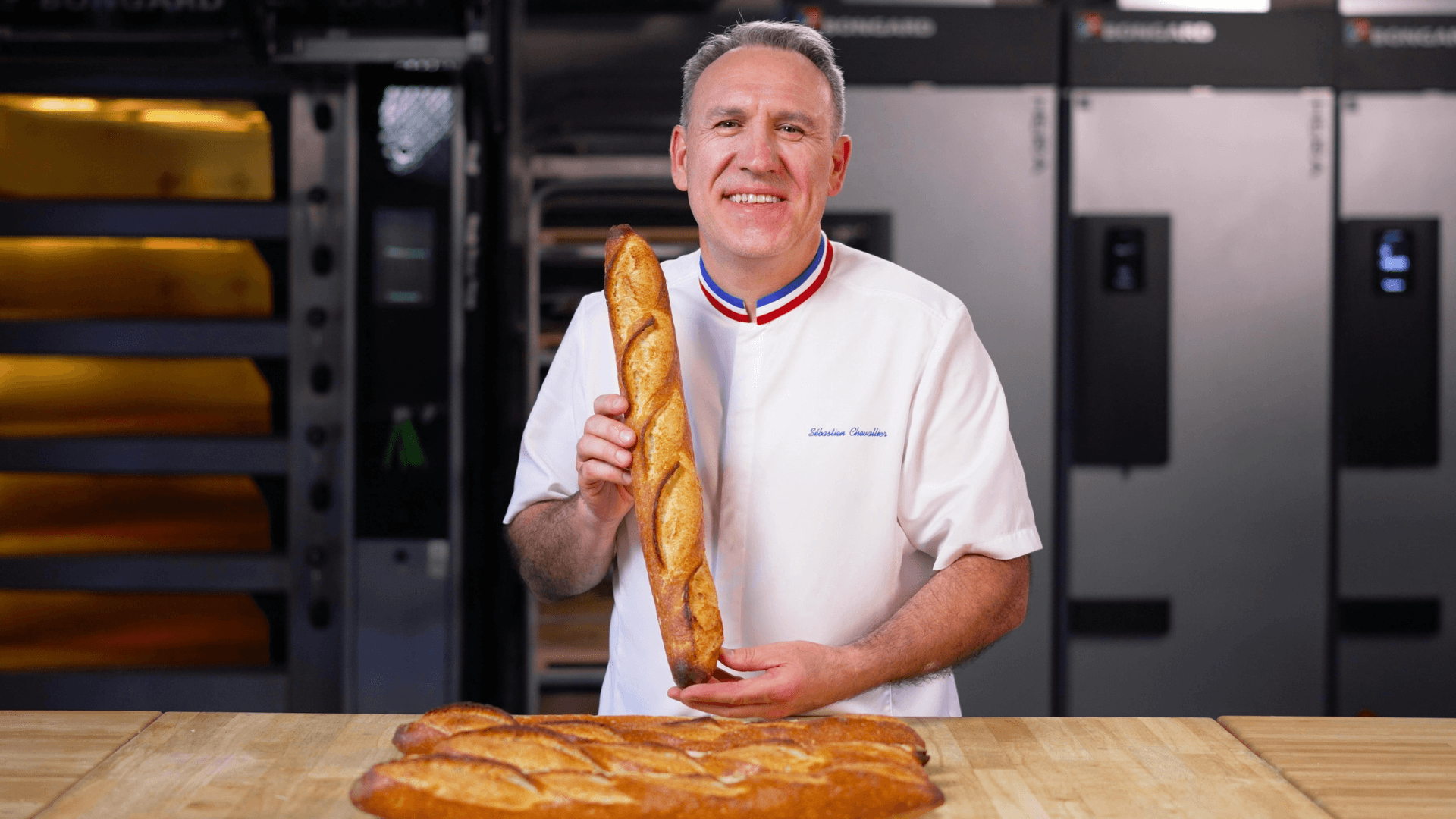
MOF bakers: Sébastien Chevallier (MOF Baker 2011, his profile), Ludovic Richard, Joël Schwalbach, Olivier Magne and Cyrille Van Der Stuyft.
-
MOF ice-cream makers: Jean-Thomas Schneider, also Ice-Cream and Pastry World Champion, and Stéphane Augé.
-
World Champions: Julien Alvarez (pastry), Alexis Beaufils and Johanna Le Pape (pastry arts), and Déborah Libs (viennoiserie).
The platform’s MOF titleholders are brought together on the Meilleurs Ouvriers de France page. The VoilaChef Chefs directory presents every profile, with the title displayed under each name.
Why train with an MOF?
A title says nothing about teaching ability, but says a great deal about the standard expected. Three practical points matter here.
A reference for results, rather than intentions. An MOF pastry Chef has been assessed on a “simply vanilla” millefeuille and a pulled-sugar piece. They know what successful lamination looks like at 18°C in a professional kitchen, rather than in a photograph. When they say “the cream is set”, they show the tip of the piping bag, the texture on the whisk and the sound. These are the reference points that someone learning alone needs.
A production perspective, rather than a display perspective. Patrice Ibarboure works in a starred restaurant, Nicolas Cloiseau in a chocolate house and Angelo Musa in palace hospitality. Their courses do not cover competition pieces that cannot be reproduced: they cover products that are sold. That is the difference between admiring and making.
A shared vocabulary. Hearing three MOFs describe the same tempering process in three different ways can change your understanding. We built the catalogue around this: one product, several Chefs and several methods.
Our honest view is that the tricolour collar is not a sufficient reason to choose training. An MOF can be an exceptional technician and a poor teacher. The only useful test is a video. If, after ten minutes, you do not know what to look for in your dough, the title will not help you.
How to include an MOF in your training pathway
Three situations call for three approaches. None involves taking MOF courses at random.
You already work as a Chef or artisan
Target a weakness, rather than a catalogue. One useful example is vanilla entremets. Take Angelo Musa’s Vanilla-lemon delight course, remake it in the kitchen the next day and compare it with your current recipe. Then work on chocolate with Paul Occhipinti if your bonbons need improvement. The pastry training catalogue is organised by product, rather than diploma level.
You are changing careers or completing initial training
The order matters. The CAP remains a foundation; online courses consolidate and broaden it. Online training does not replace hours in the kitchen or an instructor who corrects your technique in person. It lets you see more methods than your training centre can demonstrate, and revisit a specific point before an assessment. The students and career-change plan suits that rhythm, with access that does not depend on the training centre’s opening hours.
You train a team
This is the most cost-effective and least used approach. A twenty-minute briefing before service, a targeted video and a recipe to remake together: the professionals and artisans plan provides a shared internal reference. You standardise a ganache, a yule log or a sourdough loaf without keeping the entire kitchen away from production. Current prices are public: all plans.
The same reasoning applies to the bakery and viennoiserie side of your production through bakery training. For cocoa work, see chocolate and confectionery training, where two MOF chocolatiers cover tempering, moulded bonbons and decorations.
One final point needs to be made clearly: no online course prepares someone for the MOF pastry competition. Preparation takes place in a professional kitchen, with timed practice and an outside perspective. The courses broaden your repertoire; they do not coach you through a final.
Frequently asked questions
Can you become an MOF without attending a school? Yes. The rules do not set a qualification requirement: candidates must be at least 23 at the registration deadline, apply as professionals in their trade and pass the qualifying examination and final. In practice, all winners have learned within a structure — apprenticeship, training centre, compagnonnage or an establishment — because a three-day examination cannot be improvised. Becoming an MOF without formal schooling is possible; doing so without years in a bakery or professional kitchen is not.
How many MOF pastry Chefs are there? There have been 138 winners in the Pastry and Confectionery class since 1939, including six in the 2026 session, according to the count published by the MOF pastry Chefs’ association. The figure covers the history of the class, rather than only titleholders who are alive or still working.
When is the next MOF pastry competition? The 28th session was assessed in October 2026 in Bordeaux, and registration closed on 30 June 2025. No calendar for the 29th session has been published. If the previous rhythm of an opening every three to four years continues, the next could fall around 2029–2030. This must be checked on the COET-MOF website, the authoritative source.
Do online MOF courses replace a qualification? No. A CAP, BP or brevet de maîtrise validates a foundation and opens doors that video cannot. An MOF’s courses serve a different purpose: seeing high-level techniques, comparing methods and correcting a specific point. They are a complement, rather than a substitute.
Sources
-
History of the title, its formalisation in 1935, the tricolour collar (1976) and former level III classification (2001): meilleursouvriersdefrance.info
-
Organisation of the examination, current level 5 classification since 2019 and session calendar: COET-MOF
-
Classes and types of final examination for pastry and confectionery, chocolate and confectionery, ice cream and bakery: COET-MOF — final examinations
-
Account of the 28th session, with 49 registered candidates, 16 finalists, 6 winners and 138 since 1939: MOF Pâtissiers
-
Winners of the 27th session, Pastry and Confectionery class: French education ministry’s official bulletin
-
Entry requirements and qualifying examination: COET-MOF candidate portal