News / 21 November 2026
Online pastry courses: progress at your own pace
What to look for in an online pastry course, five ways to learn, and a weekly routine to turn what you watch into practical skills.
VoilaChef
21 November 2026
VoilaChef offers

With an online pastry course, a baker far from a training centre and an amateur with a home oven can both see the techniques and decisions that busy chefs rarely have time to explain. Correcting a turn when you laminate dough still takes hands-on practice and feedback. What can you learn online, and where will you need time in the kitchen?
Learners who make progress choose one technique, watch it twice, try it the following week and revisit the part that caused trouble. How a course is structured and how you practise with it matter more than the time you spend watching.
Here’s what to look for in an online pastry course, how professionals and keen amateurs can use one, and how to build a year of progress into your week.
At a glance
- A structured online pastry course shows you what to look for as you practise, saving time and guesswork.
- Look for step-by-step lessons, clear skill levels and technical sheets you can use at the bench.
- Check how long you’ll have access and how quickly you can return to a particular stage of a technique.
- Good training combines five formats: step-by-step lessons, documented recipes, standalone techniques, live sessions and replays, and professional resources and community discussion.
- Set aside 30 minutes a week, work towards one goal a month and try each technique in the kitchen.
- VoilaChef brings together 47 chefs, 164 courses and 1,122 videos. The annual plan is €490, equivalent to €40.83 per month, and VoilaChef has more than 200 Trustpilot reviews.
What to expect from an online pastry course
Judge a filmed course by what you can reproduce on your own. Three things make the difference.
Step-by-step lessons
A demonstration lets you see the finished technique. A step-by-step lesson helps you identify the decisions that determine the result. With puff pastry, these include the temperature of the base dough, the number of turns, the chilling time and when to stop. The camera needs to show each of those points clearly.
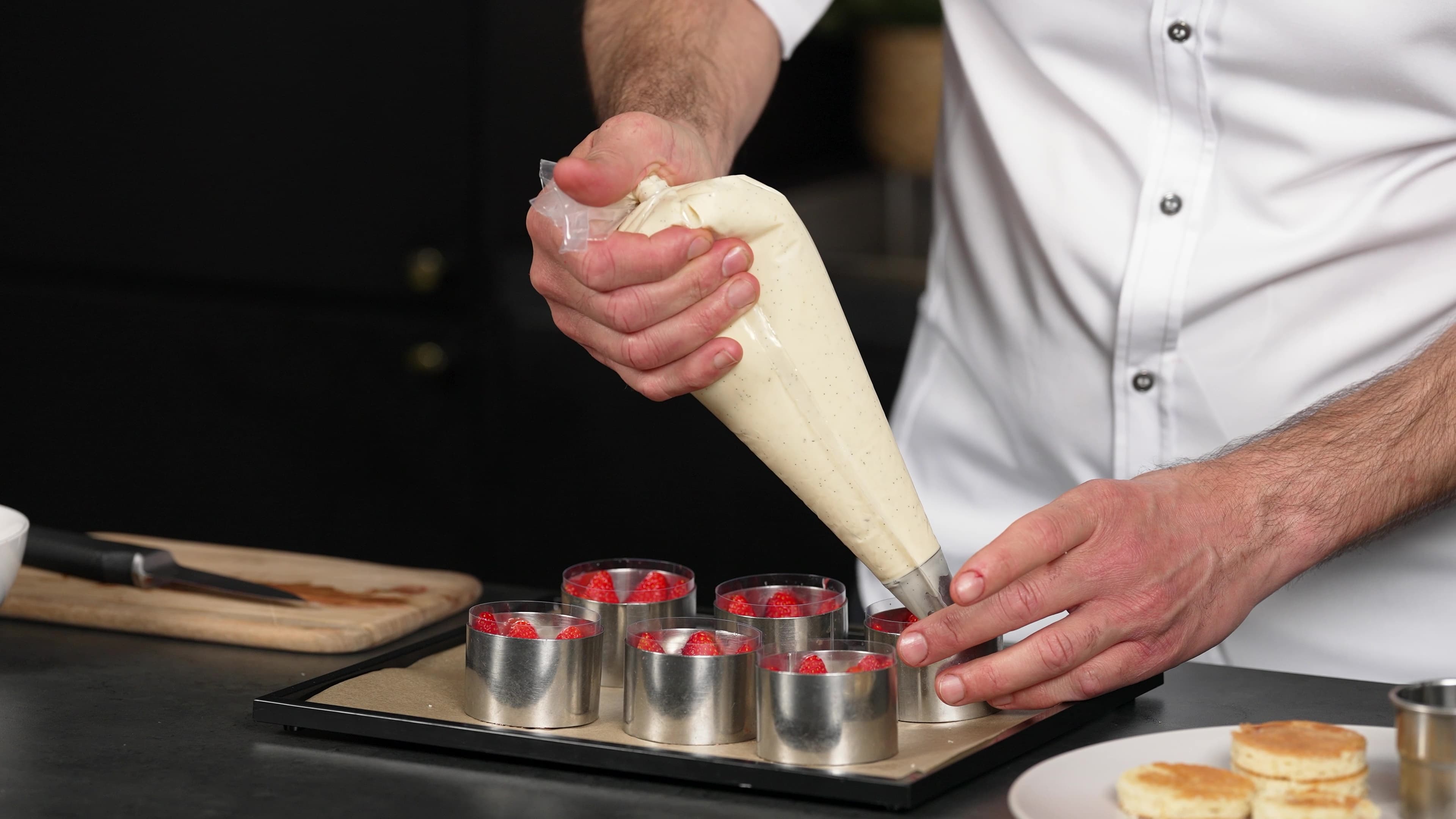
Look for short sequences filmed from several angles, with close views or pauses when the material changes. Watch the piping tip, the way cream coats the whisk, the colour of the caramel and the tension in the dough under the hand. The chef should describe what you can see and use to judge your own work.
Clear skill levels
Clear levels help you decide where to start. Useful categories distinguish the basics of doughs, creams and baking, individual techniques such as tempering, sugar blowing, piping and judging proof, and finished pieces such as entremets, showpieces, viennoiseries and plated desserts.
That structure lets you work through the same topic at several levels. Start with a basic pastry cream, adapt it for an entremets, then assess how it holds at 4 °C during six hours of service.
Technical sheets. Check that each course gives you precise weights, temperatures, yields, key checks and storage times. You need that reference as much as the footage if you want to reproduce the result. See our guide to choosing an online pastry training programme for six checks to make before paying.
Reviewing a technique
Techniques fade from memory. To judge the value of a continuing training programme, check how long you can access the lessons and how easily you can find a precise moment. If your dough is proving too quickly three months later on a Saturday morning, you’ll want to get back to the relevant minute of the right video in seconds.
A year of access gives you a reference for daily work. Check whether you can revisit an individual technique without replaying a full 40-minute class.
Five formats that make up a complete online programme
Each format serves a different part of the process: discovering, reproducing, understanding, discussing and putting techniques to work.
1. Step-by-step courses
A complete course, filmed in a working kitchen, lets you follow a chef’s choices as they work. You hear why they adjust the temperature, rest the dough or choose a particular ingredient. Start here when you’re learning a new family of products and return when you need to check the order of the steps.
2. Documented recipes
A reproducible recipe gives you the information you need to make it again. VoilaChef’s 641 verified recipes are written as production sheets with weights, yields, key checks and storage guidance. You can print them and keep them by your workstation.
3. Standalone techniques
VoilaChef documents 1,129 techniques, from tempering, lamination and piping to glazing, whipping a ganache and managing a starter. You can look up a specific issue, such as bubbles in a mirror glaze, and go straight to the ten useful minutes when you need an answer in the middle of production.
4. Live sessions and replays
Live sessions let you ask the question that occurred to you while practising. Professional webinars cover subjects such as organising a day’s production, choosing ingredients and managing a range. Replays let you catch up when service or production makes it hard to join at 6 p.m.
5. Professional resources and community
Technical articles explain the ingredients and conditions behind each result, from why a dough rises to why chocolate blooms or a cream splits. That understanding helps you adapt recipes with confidence. In a member forum, three kitchens can approach the same problem in three different ways, and one may have the answer that suits your setup.
Learning pastry online as a professional
For a chef, a section deputy or an artisan, a course has to fit into the workday and show results in the display case. A useful starting point is finding something you can add to the range while production continues.
Expand the range while the kitchen stays open. Launching a dessert menu, adding viennoiserie or developing a savoury range may involve techniques you didn’t cover in your initial training. Studying remotely allows you to test those techniques at work before investing further.
Our guide to online pastry training covers improving consistency and establishing shared methods for the team. See the professionals and artisans page for group options and training for teams.
When you work remotely, film your own technique, compare it with the lesson and try again. Prepare for a competition through timed practice in a professional kitchen. For more on the competition and what the jury expects, see Meilleur Ouvrier de France in pastry.
Learning pastry online as a keen amateur
Keen amateurs often arrive with a shelf of books, plenty of videos watched, some successes and a few failures they can’t explain. A structured course gives them ways to assess the result. You learn to recognise equal-weight mixtures, correctly whipped cream, butter with 82% fat and dough at 24 °C. These are the kinds of standards behind the restaurant and palace hotel desserts in the Guide MICHELIN’s profiles of pastry chefs. Our article on pastry courses with a chef from a Michelin-starred restaurant explains what that distinction means.
Watching a chef diagnose and fix a mistake helps you do the same the next time you work alone. Practise one family of techniques at a time. Work on doughs, then creams, then finished desserts, repeating each until your results are consistent. Three consistent entremets will teach you more about the method than fifteen unrelated attempts. See the options for passionate amateurs.
How to progress at your own pace throughout the year
Build a routine around half an hour each week and four habits.
- Set a fixed 30-minute slot. Block time before opening or on a quiet Monday. Half an hour is enough to review a technique and note two adjustments to test.
- Choose one goal a month. Make it measurable: even lamination across three batches, a stable mirror glaze, or a cream that holds at 4 °C for a service. Use the month’s lessons to meet that goal.
- Put it into practice within seven days. If you’re a professional, work it into a batch you already have scheduled. If you’re working at home, try it the following weekend, even in a small quantity.
- Review the exact step before you start. Ten minutes before making the product, reopen the clip or the sheet, check the critical points, then work from memory and observation.
Students and career changers can use this routine to complement a formal programme. See the offer for students and career changers. For the wider career path, see our guide to becoming a pastry chef.
VoilaChef, a platform for excellence in bakery and pastry training
Progress throughout the year at your own pace, with the skills, techniques and innovations shared by leading chefs. VoilaChef brings step-by-step courses, recipes, techniques, live sessions, professional resources and community discussion together to help professionals and keen amateurs develop their knowledge and refine their practice.
VoilaChef is designed for continuing training, with year-round access and lessons from working chefs. You can use the resources while preparing for service or to look up a technique during production.
- 47 chefs and instructors, including Meilleurs Ouvriers de France, World Champions and palace hotel chefs. Explore the chefs and our guide to Meilleurs Ouvriers de France.
- 164 courses and 1,122 training videos in pastry and bakery, with viennoiserie, chocolate and confectionery, ice cream, and savoury and catering alongside.
- 641 verified recipes and 1,129 techniques, with technical sheets for weights, temperatures, key checks and storage.
- €490 paid annually, equivalent to €40.83 a month, or €59 a month with a 12-month commitment. The offer for students and career changers costs €294 a year. See the pricing page for details and conditions.
- More than 5,000 professionals supported since VoilaChef launched and more than 200 Trustpilot reviews.
Use the platform to learn from chefs you might otherwise have little chance to meet, to review lessons over 12 months and to bring technical sheets into production. Hands-on feedback, placements and qualification programmes remain part of learning the profession.
Frequently asked questions
Can you really learn pastry online?
Yes. You can learn the principles, proportions, critical points and methods through video, with the option to revisit a step at any time. Develop the physical skills through practice. Watch, reproduce the technique within seven days and revisit the point where you ran into difficulty.
How much time should you set aside each week?
Start with a regular 30-minute slot, then schedule time to practise what you watched. A weekly half-hour adds up to around 26 hours of study over a year, spread across the moments when the techniques are useful to you.
Can an online pastry course replace training in a school?
A CAP, BP or BM assesses core skills and leads to a French qualification. VoilaChef provides continuing training. It does not award these qualifications. School gives you a structured programme and hands-on time with the ingredients. VoilaChef complements it with techniques you can revisit as your practice develops.
Do you have to be a professional to take VoilaChef courses?
No. Membership gives you access to the full catalogue and formats. Professionals can work on consistency and repeatability. Amateurs can learn the vocabulary, reference points and techniques that help them assess their work. The pricing page sets out the options for each audience.
Sources
- COET-MOF — Un des Meilleurs Ouvriers de France exam, including the qualification rounds, final, minimum age of 23 and jury.
- Guide MICHELIN — Profile of pastry chef Maxence Barbot, Le Bristol Paris, on the standards of pastry in a palace hotel.