Blog / 24 December 2025
How to make macarons?
Learn how to make successful homemade macarons with a detailed, sensory method simple, beginner-friendly, and reassuring.
Sandra Zwingelstein
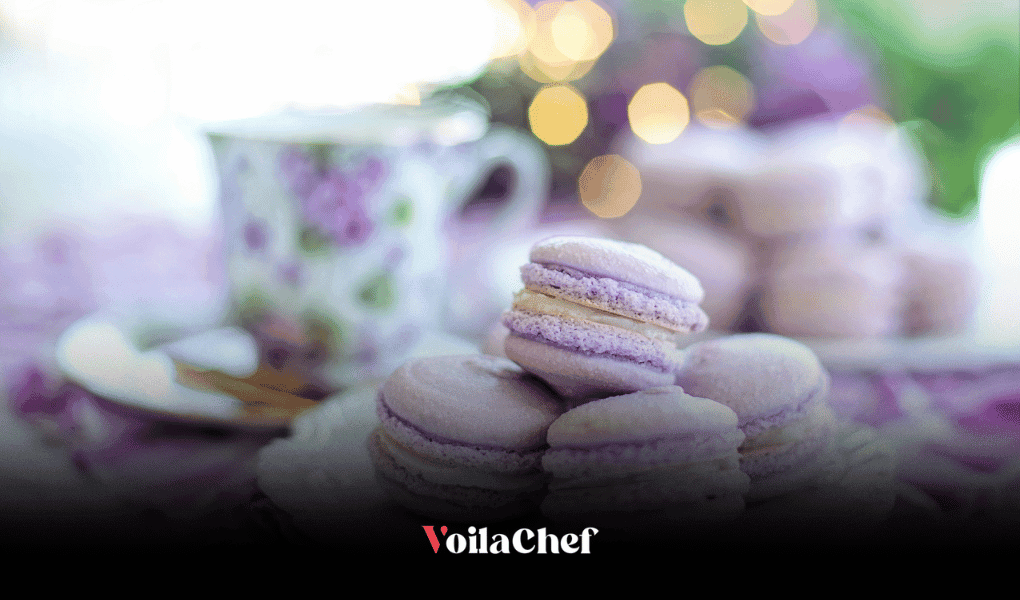
Do you dream of making homemade macarons with a smooth shell lightly crisp on the outside and a soft, chewy centre, filled with a fragrant ganache? You’re absolutely not alone: it’s a very common pastry goal, and there’s something deeply satisfying about pulling your first batch from the oven.
Good news: this article will guide you step by step, gently, with sensory cues, clear details, practical tips, and the kindness of a craftsman guiding an apprentice.
Picture your finished macarons: glossy pastel rounds, even and neat, scented with almond and vanilla; a shell that gives a slight crackle and opens into a melt-in-the-mouth texture. You bite in, and the contrast is delicate: crisp, tender, creamy.
A helpful marker: macarons rely on a very precise structure stable meringue + very dry almond flour but once you understand the gestures, it’s surprisingly accessible. Many “fails” come more from stress than from real difficulty.
In this article, you’ll discover:
- essential ingredients and their sensory role
- a detailed method for making meringue
- how to macaronage without panic
- perfect baking + how to fix common mistakes
Take your time and let yourself be guided. Sometimes you can feel the batter “breathe” under the spatula that magical moment when everything clicks.

1. Understanding a macaron’s structure: meringue, almond flour and resting
A macaron is built around an airy, silky mixture: meringue. This beating heart gives the cookie its height, its soft interior, and that smooth, lifted surface in the oven’s heat. Whisked egg whites trap countless tiny air bubbles and each bubble plays a real role in the shell’s rise.
As you whip the whites, you feel the texture become firmer and more elastic under the whisk. Sugar adds a satiny shine almost like a glossy ribbon falling back into the bowl. It often makes you smile: it looks like the start of a chocolate mousse, only even lighter.
Almond flour then brings a tender bite and a deep, comforting aroma. You can smell its sweet nuttiness the moment you open the bag. That subtle richness combined with icing sugar creates a dry base that will partially absorb the meringue. This meeting of fat and air is what makes a macaron unique: neither a simple biscuit nor a pure meringue.
You’ll also see that resting the shells is essential. During this pause, a thin film forms on the surface until it feels dry to the touch. That delicate “skin” is what gives you the perfect shell: the bottom pushes upward, creating the famous ruffled foot. It’s truly sensory when you lightly brush the top, it should feel smooth, almost like a dried petal.
It can also help to follow an online pastry course to watch these textures in real time, which makes it much easier to internalise the macaronage gesture.
To know:
- meringue provides volume
- almond flour sets the texture
- resting creates the foot
2. Meringue: the macaron’s emotional centre
Meringue is often what intimidates people most but in reality, it feels wonderful under the whisk. You start with egg whites that are still fluid. At first, you see a very fine white foam appear, almost misty. Then, in moments, it becomes dense: the texture tightens, and the surface turns more satin-like.
Sugar goes in gradually: it dissolves into the whites and changes the feel. You sense the mixture becoming shinier, more supple, and more stable. When the meringue is ready, it forms a firm peak that still has a slight bend at the tip like the crest of a frozen wave.
A good meringue can also be recognised by the sound it makes against the sides of the bowl: a faint “squeak” as the sugar integrates, a sign the texture is on track.
For successful macarons, this stage is sensory: watch, listen, and feel the density evolve. Meringue that’s too stiff breaks the batter’s flexibility. Too soft, and the shells spread in the oven. The sweet spot is a semi-firm, glossy texture that moves smoothly in the bowl.
A simple table can help you visualise:
| Visual texture | Good or bad? | Result after baking |
|---|---|---|
| Glossy, flexible ribbon | Good | Stable foot |
| Dull, dry, very stiff | Bad | Cracked shells |
| Very runny, too soft | Bad | Flat, sticky shells |
Helpful tips:
- add sugar once the whites are foamy
- whisk on medium, then high
- stop as soon as the texture turns satin-smooth
3. Macaronage: the decisive sensory gesture
This is where macarons are truly born. When you fold the meringue into the almond flour + icing sugar, you first notice a thick, crumbly texture. As you work calmly with a spatula, the batter gradually becomes supple, smooth, and almost flowing.
Macaronage means gently pressing the batter against the sides of the bowl, then folding it back toward the centre. With each movement, the texture becomes more uniform. A delicate almond scent drifts through the air soft, sweet, and comforting.
The secret? Feel the batter yes, literally. Watch how it falls from the spatula: it should form a continuous ribbon neither too thick nor too runny. This is essential. Sometimes you let the ribbon fall and it draws a line over itself before slowly melting back into the surface: that’s the perfect moment.
Too much macaronage makes the batter too loose. The macarons spread, lose their round shape, go flat, and the foot disappears. Too little macaronage gives you tall, bumpy shells that crack. This gesture isn’t “hard” or technical in a strict sense it’s intuitive.
You can also use this step to put a little of yourself into the process: sometimes your inner rhythm aligns with the circular motions of the spatula. You become calm and precise. Macaronage is where you understand that making macarons is also about connecting with a patient, steady gesture.
When the batter is ready, you transfer it into a piping bag. It feels soft and elastic, with a gentle hold. The almond aroma intensifies; the colour is pale beige, lightly powdered.
You pipe neat rounds, evenly spaced, that catch the light with a subtle sheen. Each shell should be smooth, satin-finished, and nicely round. When you tap the tray to release air bubbles, you hear a soft thud normal, and oddly satisfying.
In brief:
- watch for the batter flowing in a ribbon
- stop when it folds back into itself
- don’t chase perfection on the first try
4. Baking, resting, ganache and troubleshooting
Once the shells are piped, all that’s left is to let them rest. Wait until the surface feels dry to the touch. You can feel it with your finger: the shell doesn’t stick at all. That “skin” is the magic it’s what creates the foot.
In the oven, the moment is powerful: the aroma turns toasted, lightly sweet, almost caramelised. Through the glass, you watch the foot rise and lift the shell. The top stays smooth while the base pushes upward. It’s a beautiful thing to witness.
As the shells cool, they peel off the paper easily. The edges are crisp, the inside stays tender. You fill them with ganache, a cream, or jam. You assemble them gently, and the feeling under your fingers is very pleasant: nothing cracks, everything stays supple.
Let’s talk about common mistakes:
- If shells crack, the meringue was too dry.
- If they’re flat, the macaronage went too far.
- If there’s no foot, the resting time was too short.
Macarons improve after 24 hours in the fridge, because the filling infuses the shell. The flavour deepens. In the mouth, the result is incredible: crisp-then-melting.
Quick tips:
- rest the shells
- bake between 140°C and 160°C
- fill once fully cooled
Conclusion
You now have everything you need to make macarons that are round, tender, and incredibly satisfying to create. Let yourself be surprised by your progress, observe your batter, feel the textures, and enjoy the pleasure of making something beautiful.
And if you’d like to take this mastery further, a small detour via an online pastry course can genuinely enrich your practice gently, at your own pace.