Blog / 1 January 2026
How to make choux pastry?
Learn how to make light, puffed choux pastry step by step, with sensory tips for a perfect result every time
Sandra Zwingelstein
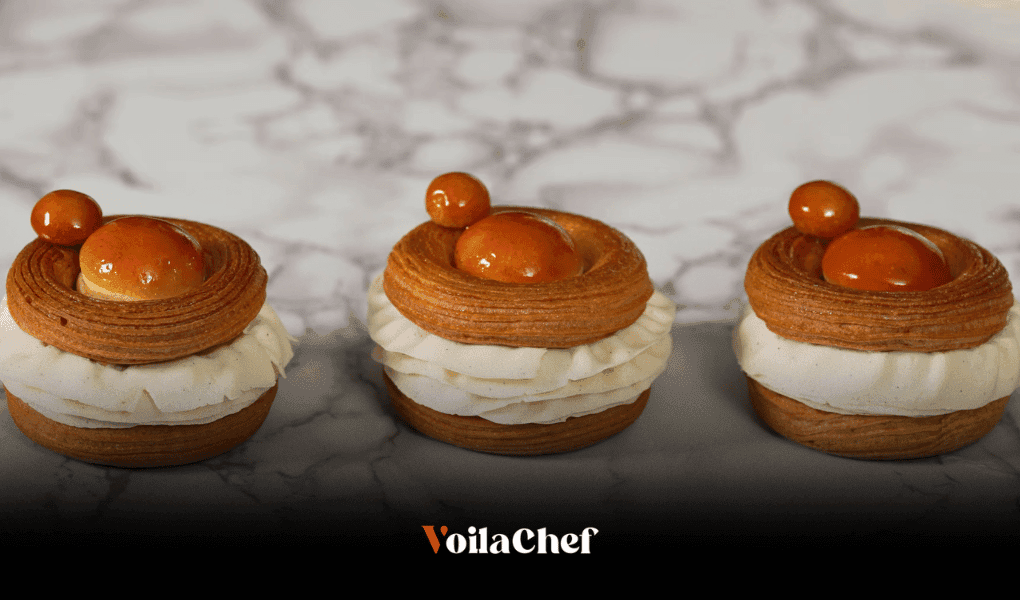
There’s something magical about choux pastry: that moment when a simple ball of warm, slightly supple dough transforms in the oven into light, hollow, perfectly golden puffs ready to be filled.
Good news: this article will walk you through it calmly, step by step, so you can succeed even if it’s your first time like a chef gently explaining and showing each gesture.
Picture it: the saucepan warming, that buttery, almost hazelnut-like aroma, the dough coming together as you stir and feel the spoon push back slightly in your hand. Then the puffs rise, turn golden, and become as light as little clouds you can’t wait to fill with vanilla-scented pastry cream.
Quick knowledge bomb: choux pastry doesn’t rise thanks to baking powder it rises thanks to water vapour trapped inside the dough. That steam expands, creates the hollow centre, and gives that irresistible volume.
In this article, you’ll learn:
- the simple, useful science behind choux pastry
- each sensory step to achieve the ideal texture
- how to bake for beautifully puffed choux
- how to fix dough that’s too dry, too runny, or that won’t puff
Take a moment, hold your spatula, and let yourself be guided. You’ll see: choux pastry quickly becomes a joyful gesture almost meditative.

1. Understanding choux pastry: gentle, delicious science
Choux pastry looks simple, but behind its apparent ease lies a delicate balance of water, fat, flour and eggs. As water and butter heat together, the aroma slowly opens up rich and comforting, drifting through the kitchen. When the flour goes in all at once into the simmering liquid, the magic begins: it absorbs the water immediately, forming a thick, smooth ball that pulls away from the sides.
In this first phase, heat hydrates the starch. It’s as if the flour granules swell into a cosy, cohesive dough. Then, when you add the eggs one by one, everything changes: the dough becomes supple and elastic, and you can see it smooth out under the spatula. Under your hand, there’s a subtle resistance almost alive. That moment when the dough falls back in a slow ribbon is the sign it’s ready.
You can already picture your next batch: in the oven, the water inside the dough turns to steam. That steam pushes from within, creating the famous hollow centre you love to fill with cream, whipped cream, or ice cream. This isn’t “technical” it’s sensory. You understand it with your eyes, your hands, and even the smell of the oven heating up.
If you ever want to go further in the art of mastering textures, you can explore an online pastry course one day but for now, let’s stay together, calmly.
Key takeaways:
- puffed choux = steam well trapped
- the dough must be smooth and supple
- the ribbon = the perfect sign
2. Step-by-step method: the sensory approach that never fails
Start by pouring the water, butter and a pinch of salt into a saucepan. As the butter melts, tiny clear bubbles appear around the edges, and a delicate buttery scent rises. It’s a moment worth enjoying. Once you see a real boil (quick little ripples), add the flour all at once like a soft white shower. Stir immediately: the dough forms. It’s sticky at first, then dense, and you can clearly feel it pull away from the bottom, leaving a thin film behind.
Remove the pan from the heat. For 1 minute, stir to let the dough cool slightly. You’ll feel the steam escaping like a warm breath. This short pause is essential to prevent the eggs from setting too quickly. Then add the eggs one at a time. At first, the dough may look separated and a bit lumpy not pretty. Don’t worry: keep mixing, and it transforms, smooths out, becomes glossy, creamy, almost satin-like.
When you lift your spatula, the dough should fall slowly in a wide ribbon that doesn’t break right away. This simple gesture tells you whether it’s ready. If it’s too firm (a ribbon that snaps): add half an egg more to loosen it. If it’s too fluid: mix for an extra minute to tighten it slightly.
Next, pipe or spoon small mounds onto a baking tray. You’ll see soft, round domes form, with a little peak you can smooth with a damp fingertip. Into the oven they go. Heat gets to work and after a few minutes, the miracle happens: the puffs rise, turn golden, and become light and nearly hollow.
Helpful tips:
- smooth the peak with a damp finger = more even baking
- stable oven temperature = better rise
- don’t open the oven too early
3. Baking success: the delicate moment where everything happens
Baking is the heart of success. Imagine it: the oven heats, the air becomes dry and hot, almost enveloping. The puffs rise in silence, like tiny bubbles coming to life. You watch their skin turn golden and slightly matte, sometimes with a small elegant crack. That’s normal the steam is still pushing.
In the first minutes, the oven must stay closed. If you open it too early, the steam escapes and the puffs collapse sadly. Wait until the colour develops and the surface feels set, then crack the door open briefly to release humidity. This is what creates the light, crisp texture we love.
At the end of baking, you can leave the puffs for another 5 minutes in the switched-off oven with the door slightly open. This dries them gently and prevents them from softening as they cool. When you touch them, they should feel light, hollow almost “sounding.” The base should sound slightly hollow when tapped.
For filling, wait until they’re cold: cool cream against a dry puff creates the perfect sensation tender and indulgent at once. Vanilla whipped cream, pastry cream, ganache, ice cream… everything works. That’s where creativity wakes up.
In brief:
- don’t open the oven at the start
- golden colour = a good sign
- final drying = guaranteed crispness
4. Fixing common mistakes (without stress)
If your puffs don’t rise, go flat, or stay too pale, it’s usually a small detail that’s easy to correct. Nothing to worry about. Dough that’s too runny will spread in the oven. Next time, add a little less egg or dry the dough a bit more in the saucepan. You’ll feel the difference under the spatula: ready dough is supple but holds its shape.
If your puffs stay pale, the bake may need more heat or more time. Add a few minutes and watch the colour. They should turn golden, slightly amber like a very delicate bread crust.
If your puffs rise and then collapse, too much moisture stayed trapped inside. Briefly opening the oven halfway through helps dry the interior. If it’s already happened, you can still fill them: even a flatter puff can be delicious with a generous cream.
Remember: choux pastry isn’t a battle it’s a dialogue. The dough speaks through its texture, its shine, its resistance. By watching it and touching it, you learn.
Quick cues:
- flat = dough too runny
- pale = baking too short
- collapsed = moisture not released
Conclusion
You now have all the basics gestures, cues, and sensations to make choux pastry that’s puffed, light, and genuinely enjoyable to prepare. Take your time, observe, smell, and let your hands learn. And if one day you want to go further, an online pastry course can turn that pleasure into true know-how.