Blog / 18 January 2026
Croissant lamination
Discover croissant lamination explained step by step, with gestures, textures, and baker’s tips for light, crisp, beautifully layered croissants.
Sandra Zwingelstein
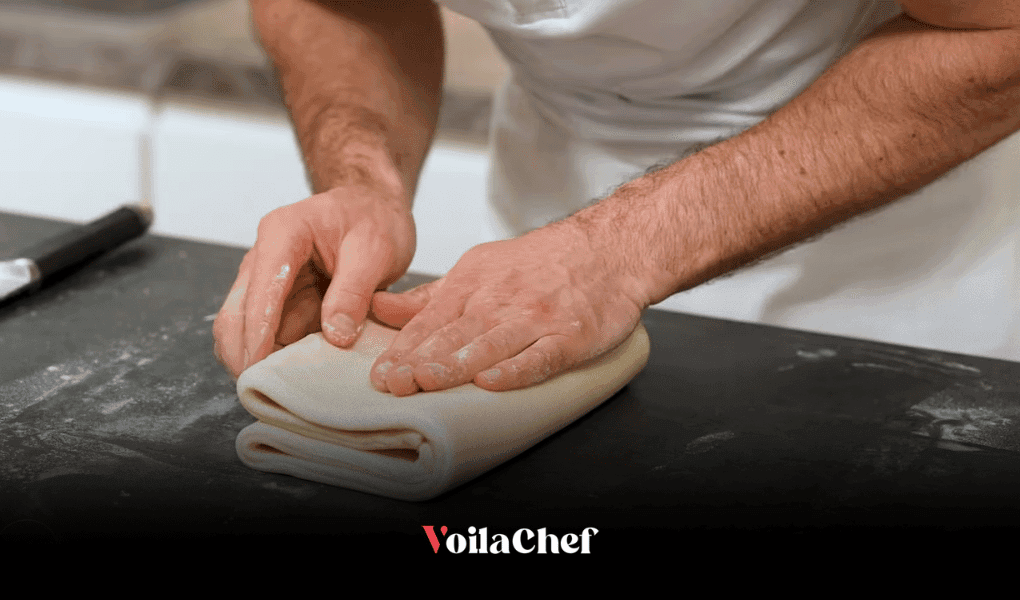
You dream of light, flaky croissants, with those fine layers that separate effortlessly between your fingers and that unmistakable aroma of warm butter filling the kitchen as soon as they leave the oven.
Good news: croissant lamination isn’t reserved for professional bakers. With the right guidance, it becomes accessible, enjoyable, and deeply satisfying. This article will walk you through the process step by step, with gentleness, precision, and plenty of reassurance.
Imagine a dough that’s still cool and supple under your palm, a smooth, cold butter layer slipping neatly between folds, then that magical moment in the oven when the dough opens up into airy honeycomb layers golden, crisp on the outside, tender and melting at the core.
Here’s a gentle knowledge bomb: great croissant lamination relies far more on temperature control, resting time, and steady, regular gestures than on speed or strength.
In this article, you’ll discover:
- what croissant lamination truly is
- how to prepare a stable laminated yeast dough
- precise lamination gestures, stress-free
- common mistakes and how to avoid them calmly
Take a deep breath, lightly flour your work surface, and let yourself be guided you’ll soon see that lamination becomes both a pleasure and a true craft.

1. Understanding croissant lamination: a living, delicate dough
Croissant lamination isn’t just about stacking layers. It’s a living dough—one that breathes, relaxes, and reacts to the smallest temperature change. From the very beginning, you can feel its elastic, slightly cool texture under your fingers, already hinting at the fermentation work to come.
Unlike classic puff pastry, croissant dough is a laminated yeast dough. This means it contains yeast, which produces gas and creates those irregular air pockets so characteristic of a well-made croissant. Lamination doesn’t just separate layers—it guides and supports the dough’s rise from within.
When you touch a well-prepared dough, it feels neither sticky nor dry. It holds together, stretches gently, then springs back just a little. This tactile feedback is essential: it tells you the gluten network is strong enough to handle lamination without tearing or stress.
Butter plays an equally fundamental role. It must be plastic—firm yet flexible. Too cold, and it cracks, piercing the dough. Too soft, and it leaks, blending into the dough instead of forming layers. When pressed, it should flatten smoothly without melting, almost like silky modelling clay.
To remember:
- croissant lamination uses laminated yeast dough
- touch and feel are key indicators
- butter and dough must be at similar temperatures
2. Preparing the dough before lamination: patience and consistency
Before talking about turns and folds, the base dough deserves careful attention. A well-prepared dough makes the entire process smoother and more forgiving. From the kneading stage, the goal is a homogeneous, smooth dough that feels slightly cool, never overworked.
As you knead, watch the transformation. At first, the dough may feel a bit rough and uneven, then it gradually becomes supple and almost silky. This precise moment matters: too much kneading makes the dough tight and nervous; too little leaves it fragile. The goal is a dough that pulls away from the bowl and stretches without tearing.
Next comes resting time a step often underestimated, yet absolutely essential. During rest, the dough relaxes, gluten loosens, and fermentation begins gently. Under your fingertips, it becomes calmer and more cooperative, easier to roll out without fighting back.
When rolling the dough to enclose the butter, take your time. The surface should be even, with no thick or thin patches. The movement is slow, steady, almost meditative. You feel the dough stretch, open, and settle calmly under the rolling pin.
At this stage, many bakers gain confidence through visual reference. An online pastry course can help you clearly see how the dough should behave before lamination—removing much of the uncertainty.
Quick tips:
- avoid over-kneading
- respect resting times
- roll the dough evenly and calmly
3. Lamination: the heart of croissant making
Lamination is where the magic truly begins. This is where layers are created and structure takes shape. Movements should remain calm, precise, and unhurried. With each turn, the dough becomes smoother and more uniform.
When enclosing the butter, pause for a moment and feel the dough under your hands. Dough and butter should offer similar resistance. As you roll, you sense the butter spreading into a thin, even layer almost invisible, yet fully present.
Each turn involves folding the dough over itself, creating successive strata. After the first turn, the dough already feels more organised. After the second, it becomes denser and more regular. Between each turn, resting in the fridge is essential it allows the butter to firm up again and the dough to relax.
After resting, the dough feels cool, firm yet flexible to the touch. That’s the sign it’s ready for the next turn. If it resists or shrinks back, simply give it more rest. No stress the dough always communicates, if you listen.
The number of turns matters, but consistency and regularity matter more. Well-laminated dough shows clean, parallel layers when cut fine lines that promise even, beautiful development in the oven.
Helpful tips:
- work on a lightly floured surface
- respect cold resting times
- roll gently, without pressing too hard
4. Recognising good lamination and avoiding common mistakes
Good lamination can be recognised long before baking. When cut, the dough reveals clean, even layers, without marbling. To the touch, it feels cool, supple, and slightly elastic. These cues are reassuring and invaluable.
In the oven, lamination develops vertically. Croissants rise, layers lift, and an airy, light structure appears. The smell of warm butter and golden dough fills the air a clear sign the groundwork was done well.
Common mistakes include butter that’s too soft and escapes, or dough that’s too warm and loses structure. In these cases, layers merge and the result feels dense. Fortunately, these issues are almost always temperature-related and easily corrected with proper chilling.
Another key issue is rushing. Moving too quickly prevents the dough from relaxing. Taking your time, respecting pauses, and observing texture nearly always leads to a more even, harmonious lamination.
Finally, remember that every oven, butter, and flour behaves slightly differently. Adjusting, observing, and feeling are part of the learning process. That’s what makes lamination such a living, fascinating craft.
In brief:
- good lamination is visible when cut
- temperature control is essential
- patience makes all the difference
Conclusion
Croissant lamination is a delicate yet deeply rewarding skill. By respecting time, textures, and gestures, you’ll quickly see your croissants gain lightness, definition, and character. And if you feel the desire to go further, an online pastry course can support that progression with clarity, calm, and precision.